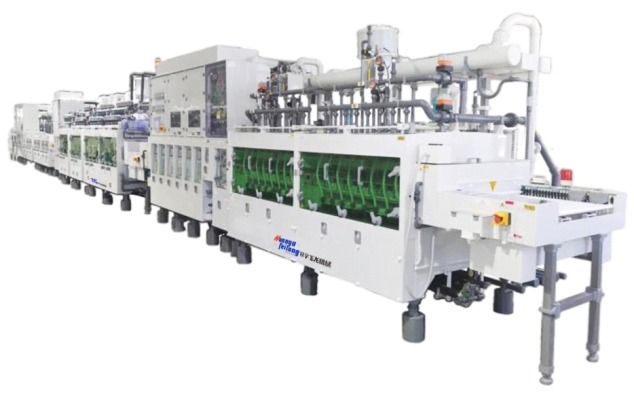
The alkaline etching machine is used for the outer layer of circuit boards, large-scale double-sided board production, and the production of aluminum substrates. Its alkaline etching process has the advantages of cost-saving and easy control.
(D) Developing
In photofabrication, developing is the post-exposure process.
Dissolve and remove the photoresist other than those required and form a pattern image of the photoresist.
There is a “soaking method” of immersion in the developer and a “spray method” of spraying, and there is a common use of spray methods in terms of supply efficiency of the developer.
Immediately after the development, a set of heating treatments called post-baking are carried out.
The post-baking box hardens the photoresist, which results in resistance to etching fluid in the next process and improves adherence to substrates.
(E) Etching
Etching is a post-developing process.
While continuously transporting using etchants suitable for metal materials (products), a large amount of etching is performed uniformly by the spray method.
As the management of the etchant is important, an etchant autoanalyzer is installed as a supplementary facility, and various chemicals are automatically supplied based on the feedback of each component analysis to maintain a constant etching rate.
(S) Stripping
Stripping is the post-etching process.
After etching, dissolve the unnecessary photoresist film.
Depending on the type of photo registry, sodium hydroxide heated around 40 to 80℃ or 100℃ is commonly used.
In the case of special resist, mixed solvents such as xylene, alcohols, and ketones may be used.
If the product cannot be stripped by immersion, physical force such as a brush or spray is applied to the product. Immediately after stripping, De-ionized water cleaning, drying, and rust prevention are performed as a set.








)